|
|
|
You’ll not find a wider selection of wilderness adventures than Slickrock Expeditions has to offer. They go from the southwestern deserts to southern swamps and from the Appalachian highlands to the mountains of the Pacific Northwest. Slickrock guide Burt Kornegay leads each trip and provides all permits, food, and gear (including sleeping bags and tents), as well as local transportation. B&B’s, lodges, and historic inns are part of many trips.
|
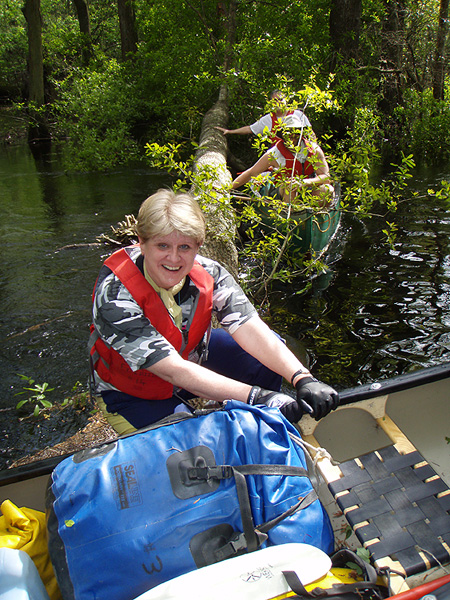
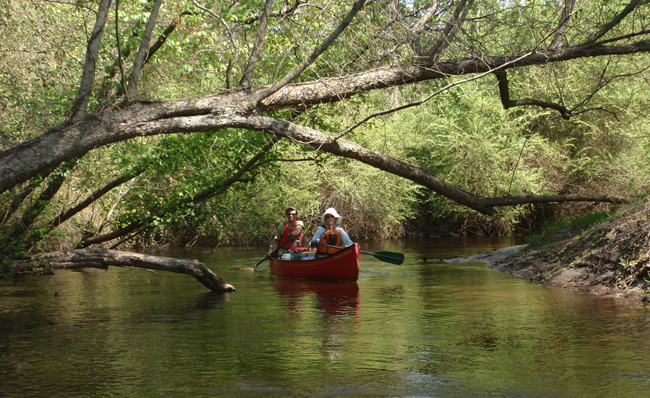
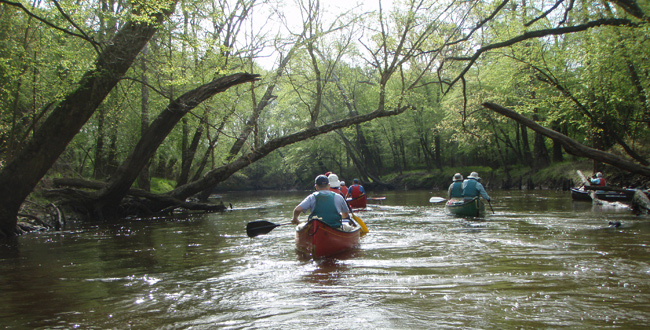
Flowing out of Mingo Swamp, in eastern North
Carolina, the small, intimate South River twists and turns its way through forests of moss-draped
cypress, oak, and pine for 85 miles, until it joins the Black River on the Pender County line.
In “Paddling Eastern North Carolina,” Paul Ferguson notes that a trip down the South “is mainly one
of splendid isolation.” One of the most beautiful blackwater streams in the coastal plains, the
South has been designated an “Outstanding Resource Waters” by the state. On a recent trip down the
South, we saw beaver, otter, raccoon, weasel, deer, owls, herons, wood ducks, and hawks. Taking advantage of prime spring weather for
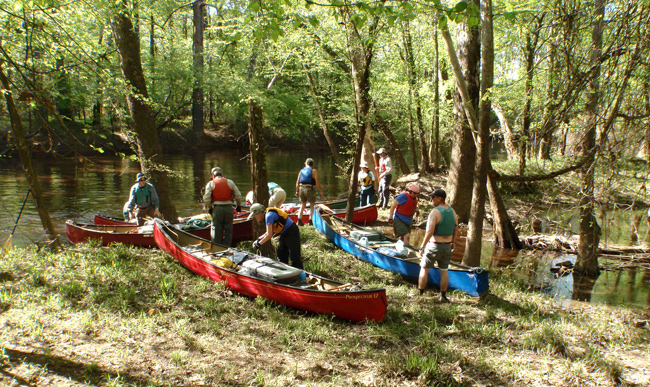
this 3-day canoeing adventure, we’ll meet in the
morning at Jones Lake State Park, near Fayetteville, for a canoeing tune-up and
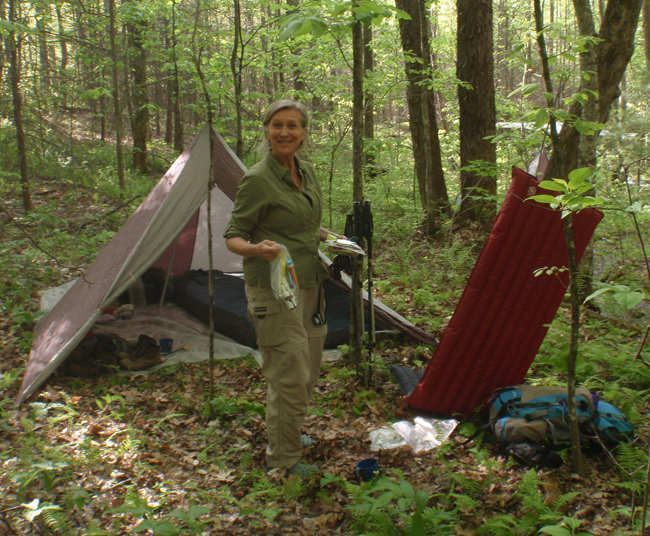
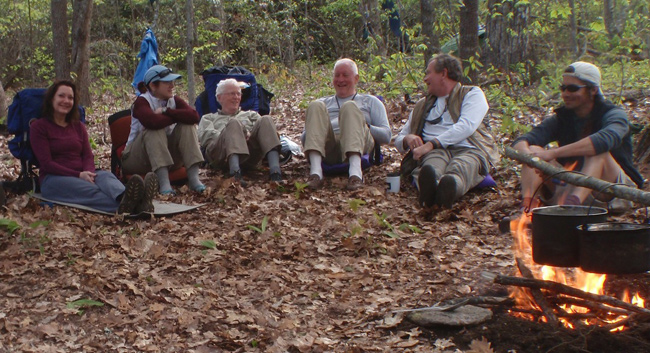
picnic. Then, launching on the South, we’ll spend the weekend canoeing a 30-mile
stretch through its remote forests and camping two nights on the riverbank.
Cost: $400 (deposit:
$200) Group size: 14
Dates: April 4-6
*Because of strong interest in this trip, a second South River Exploration has been added:
Dates: April 11-13.
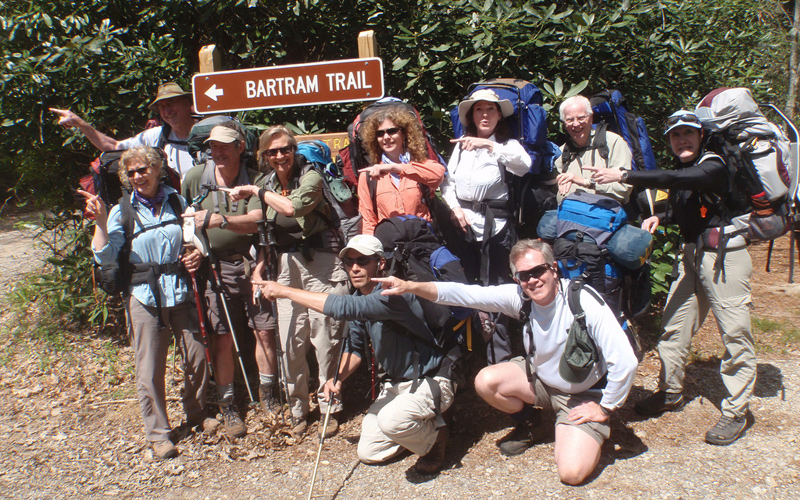
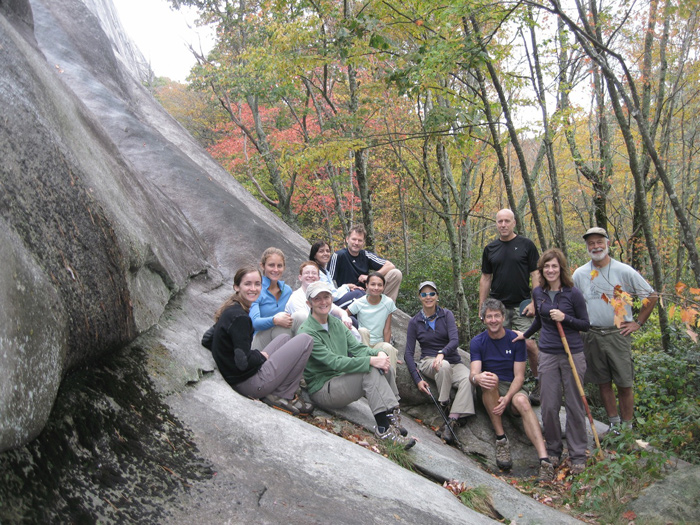
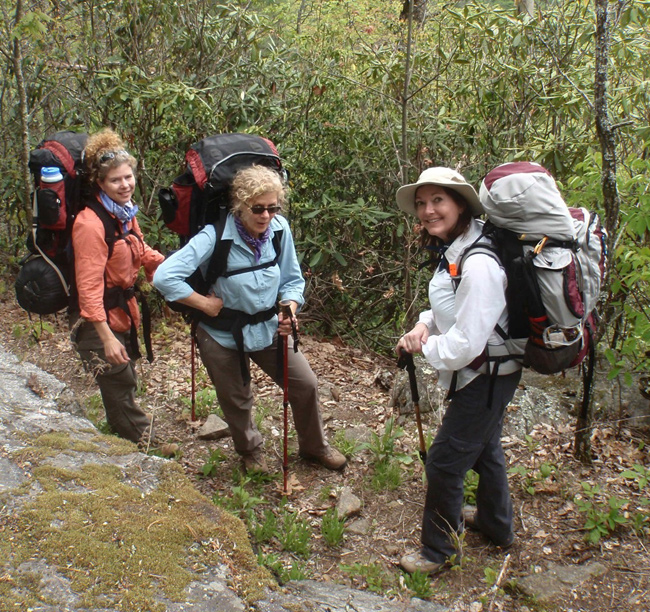
This will be a 3-day backpacking
trip covering 15 miles in Sections 1 and 2 of the Bartram National Recreation
Trail, in the Nantahala National Forest of western N.C. The trail follows
the spine of the Fishhawk mountains, and we’ll hike over Scaly Mtn.
Jones Knob, and Whiterock Mountain, all three providing sweeping views of
the Southern Appalachians. In addition to far-off vistas, we’ll see
spring wildflowers up close, we’ll camp two nights, and listen to selections
from the writings of the early naturalist, William Bartram, who explored
this area in 1775 and wrote about the land and the native Cherokee in his Travels.
Coming off the trail the last day, we’ll go to ancient Nikwasi Mound,
of the Cherokee, which Bartram also visited.
Cost: $350 (deposit:
$150) Group size: 12
Dates: May 2-4
Good
weather, good company, good hiking, good food, and as always the
best trail guide one could ask for. I don't know anyone who would
lead nine people to the top of a mountain and read such sensual writing
about flowers, trees, storms and other beauties of wild life. It's
this kind of thing that makes your trips unique. |
Corinne
Cooper |
Western
North Carolina offers some of the best canoeing in the country. And this
3-day adventure on the region’s waterways, with nights spent at secluded
Balsam Lake Lodge, is for those who want a complete introduction to wilderness
canoeing, from lakes to whitewater rivers. The first day will be spent on
Balsam Lake itself, where we’ll learn and practice flatwater canoeing
strokes and maneuvers, then we'll go to the Tuckaseegee River and begin to
learn how to “read” such
river features as chutes, eddys, pillows, and wave trains. The second day
we’ll
canoe a class I stretch of the upper Tuckaseegee and practice such
important river maneuvers as eddy turns and peelouts, river ferries and side-slips.
On the third day we’ll put it all together by canoeing through
the Tuckaseegee’s Dillsboro Gorge, where we’ll sharpen the skills
we’ve learned, while paddling through Class II rapids. We will also
learn techniques of safe whitewater canoeing, including the proper outfitting
of canoes for wilderness tripping and the use rescue “throw ropes.” If
the weather is warm, we will even have the chance to “swim” a
couple of rapids and throw rescue ropes to each other.
We’ll spend both nights of each clinic at Balsam
Lake Lodge, in the Nantahala National Forest, where in the evenings we’ll
watch canoeing videos. The goal of the clinic will be to give you the know-how
you need to become a competent and confident wilderness boater and to teach
you the skills needed for remote river canoeing trips. All canoeing techniques
will be taught in accordance with the guidelines established by the American
Canoe Association, and participants will receive an ACA course participation
card.
Cost: $525 (deposit: $250). Group size: 12.
Dates: May 30- June 1; June 6-8
Gary
and I have told everyone who would listen about our great canoeing
experience and our terrific instruction! Hardheads like us are tough
customers, but you did it. |
Gail
Budd |
Fed
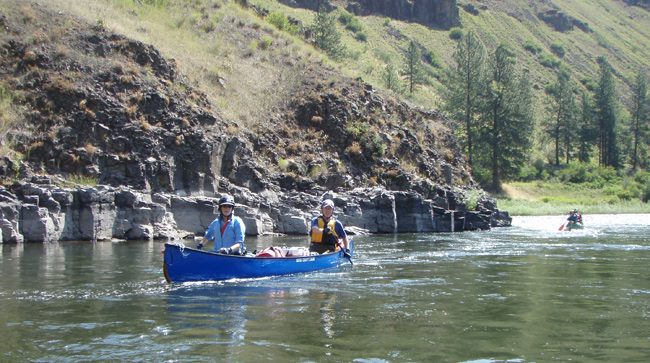
by the melting snows of the Elkhorn and Wallowa Mountains (“the Oregon
Alps”), the Grande Ronde River and its swift tributary, the Wallowa,
flow north through the canyons of the Blue Mountains of Oregon and Washington
to join the Snake River, on the Idaho border, at Hellers Bar. Designated
a National Wild and Scenic River, the Grande Ronde is described in Western
Whitewater as “one of the most scenic river trips in the Pacific
Northwest.”
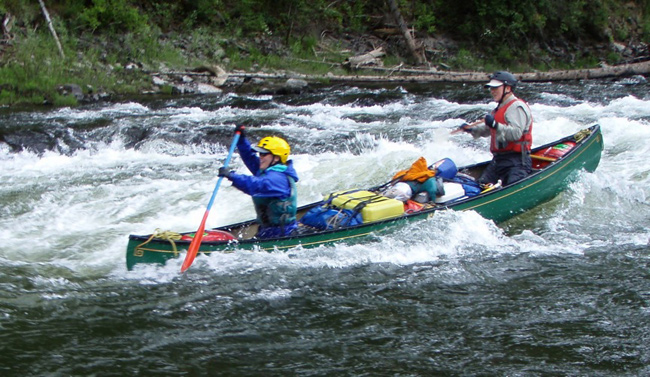
On this 7-day Expedition, we’ll spend the first day and
night at Wallowa Lake Lodge and ride an aerial tram to the snowcapped peaks of
the Wallowa Mountains, “the
Oregon Alps,” to see where the river starts. Then, putting in at “head
of the canyon,” we’ll canoe for 100 miles down the Wallow and Grande
Ronde through Class II-III rapids. The
river moves at about the same fast pace as North Carolina’s well-known
Nantahala River, but without the crowds, through canyons up to 3000' deep.
We’ll stop to look at abandoned pioneer
homesteads and perhaps spot some of the many kinds of animals that live along
the river. On past trips we have seen black bears, mule deer, elk, big horn
sheep, river otter, bald and golden eagles. We’ll also “canoe in” to
enjoy homemade milkshakes at two river outposts: Shiloh Café and Boggan’s
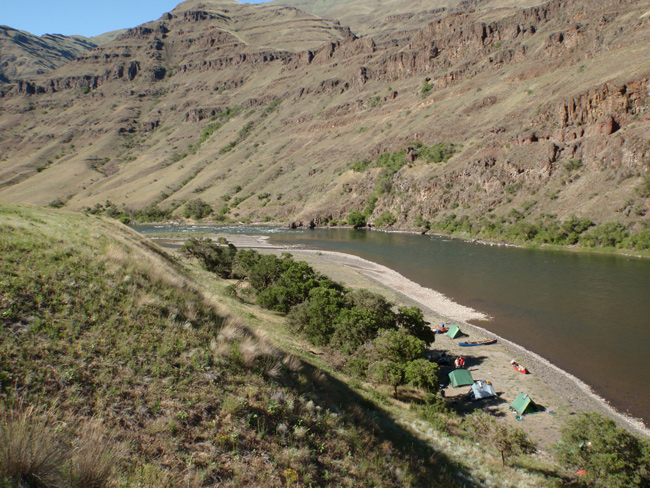
Oasis. We’ll canoe for 5 days and camp 4 nights on the river and spend
our last night at the High Country Inn, in Orofino, Idaho, where the food doesn't
come any finer. On the last day we’ll take a sight-seeing drive through
western Idaho on our way back to Boise, along the Salmon and Payette Rivers.
Trip cost includes all food and gear for the canoeing trip, shuttling and permit
fees, lodging at Wallowa Lake Lodge, and lodging and breakfast at the High
Country Inn, along with transportation from the
meeting site, Boise, ID. Canoeing experience required; inquire.
Cost: $1550 (deposit: $750). Group size: 12.
Dates: July 2-10.
I've
been waiting for "divine inspiration" to find the right words to
thank you for our glorious trip to Oregon's Grande Ronde River. .
. . our memories of that wonderful week are powerful medicine against
the hum-drum of daily life. We look at our pictures and talk, sigh
and laugh about all that we saw and did. And we keep saying, as we
do after every one of your trips, "this just may have been the best
yet!" |
Martha
Moore
|
Of
a “River Run’s Through It” fame, Montana’s clear
and beautiful Blackfoot River flows west from the high Rockies to Missoula,
where it merges with the Clark Fork River. In it’s upper half the Blackfoot
is a clear stream, twisting through a forest of cottonwood and cedar trees,
full of wildlife, and with views out to ranches and mountains. Then midway,
the river turns a corner into Class I rapids, the cottonwoods give
way to conifers, and the gravel bars change to cliffs and rocks. From there
on the Blackfoot steadily picks up steam, growing to Class II and III rapids
on its lower end. Here’s what the guidebooks say. Paddling Montana, “The
Blackfoot . . .is a dashingly beautiful stream that provides outstanding
whitewater excitement and incredible scenery.” Montana Afloat,“Perhaps
no river in Montana has more calendar-art scenic beauty per mile then the
legendary Blackfoot.” Floating Montana, “The Blackfoot
. . . has everything! Beautiful scenery, fishing, whitewater, and a riparian
habitat that supports large populations of big game, eagles, waterfowl, and
other wildlife.”
Starting in its headwaters near the town of Lincoln,
we’ll canoe our way down this wilderness river for 5 days, looking for
wildlife, paddling the rapids, and camping on the riverbank. The trip will
end at Johnsrud Park, near Missoula and from there we’ll drive north
to spend the last night at Cougar
Ranch B&B, near the spectacular Mission Mountains.
Trip cost includes all gear and food while on the river, local transportation
and shuttling, and lodging and breakfast at Cougar Ranch. Trip starts and ends
in Missoula, MT.
Cost: $1450 (deposit:
$700). Group size: 12.
Dates: July 12-18.
![]()
Panthertown
Valley lies in the Nantahala National Forest of N.C.’s Blue Ridge
Mountains. Described as a “miniature national park” and as “the
Yosemite of the East,” this wild area has deep gorges, granitic rock
domes and cliffs, tranquil creeks, and spectacular waterfalls, all within short
hikes of one another. The area is composed of rock a billion years old, pushed
up into Himalayan-high mountains 300 million years ago, subsequently worn down
by the forces of nature to form part of the Southern Appalachians, one of the
oldest, most complex mountain ranges in the world.
On this 3-day adventure, we’ll set up camp for two
nights in a beautiful white-pine forest on Panthertown Valley’s floor,
and, hiking out from there with daypacks only, explore the valley and places
in it that are rarely seen by others, including Fat Man’s Misery, Skinny
Man’s Delight, Red Butt Falls, Devil’s Den, and Protector’s
Pool. In addition to exploring
beautiful places, we’ll learn about
the natural and human history of the valley, from the Cherokee to the present
day. In the evening we’ll
return to camp to enjoy a meal cooked over an open fire–and perhaps hear
the howlings of Panthertown’s resident
pack of coyotes.
Cost: $350 (deposit: $175). Group size: 12.
Dates: Sept. 26-28
I
know I have not experienced the outdoors on three consecutive days
any more gorgeous than those three in Panthertown, nor have I been
on a hike as beautiful and diverse as Sunday's day trip. |
Haynes
Lea |
To order "A Guide's Guide to Panthertown Valley" trail map, click here.
![]()
Taking advantage
of the third weekend in October, which usually marks the “peak” of
the fall color season in the Southern Appalachians, we’ll hike 3 different
trails in the high country and spend two nights at Balsam Lake Lodge. On Friday
we’ll explore Section 2 of the Bartram National Recreation Trail, in
the Fishhawk Mountains. Our destination will be the overlook on Whiterock Mountain–providing
one of the most stupendous views in the southern mountains, of the Little Tennessee
River Valley and the Nantahala range. On Saturday, following a winding loop
route, we’ll search out some of the guide’s favorite places in
Panthertown Valley, including Fat Man’s Misery, Blackrock Overlook, the
Great Wall of Panthertown, Granny Burrell Falls, Foamy Falls, and the Elevator
Shaft. And then on Sunday we’ll cap it off with a “world-class” dayhike
through Bonas Defeat Gorge, one of the wildest places in the East. These will
not be backpacking hikes, though participants will carry their lunches, water
bottles, and whatever they may want to have for the day. In the evenings we’ll
relax at secluded Balsam Lake Lodge, nestled in the “Little Canada” area
of the Nantahala National Forest.
Dates: Oct. 24-26.
Cost: $500 (deposit, $250).
Group size: 12.
![]()
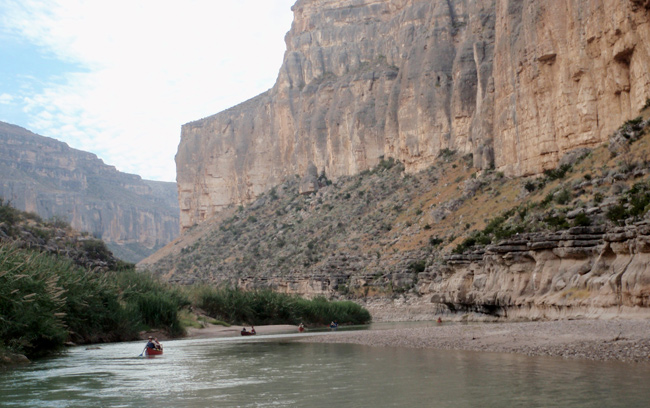
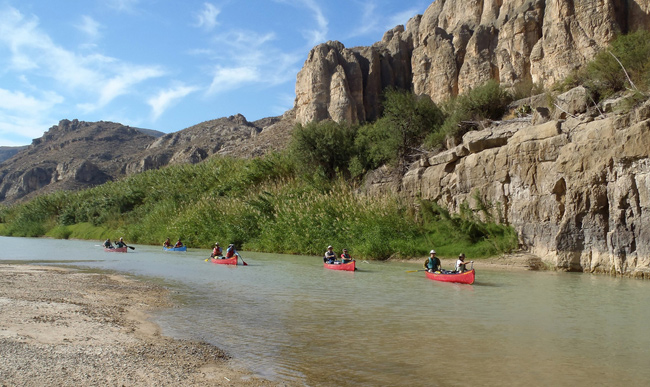
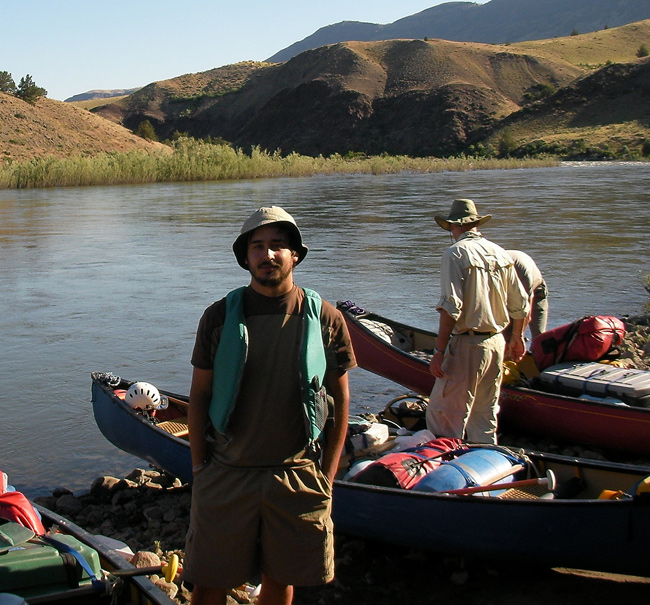
The ancient Indians said it was the place where the
Great Spirit dumped all of his leftover rocks after making the world.Spanish
conquistadors called it "the Uninhabitated Land and "the Great Unknown."
Nineteenth-century explorers described it as "unparalleled for ruggedness and
wildness of scenery." And today the rugged topography of Big Bend National
Park, Texas, is recognized by everyone who goes there as some of the most spectacular
in the Southwest. It is a monumental region of rocky volcanic peaks, uplifted
limestone fault blocks, and
"stone box" canyons in the Chihuahuan Desert, with strange forests of giant
dagger yuccas and dozens of species of cacti. Giving shape to the "Big Bend" itself
is the Rio Grande, one of the most remote rivers in the lower 48. Designated
a National Wild and Scenic River and managed by the National Park Service,
the Rio Grande flows in canyons up to 2000 feet deep and forms what the Park
Service calls a green "linear oasis" between Texas and Mexico.
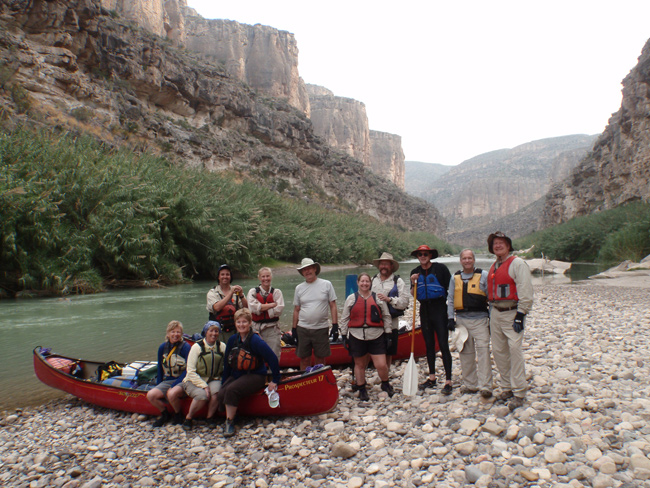
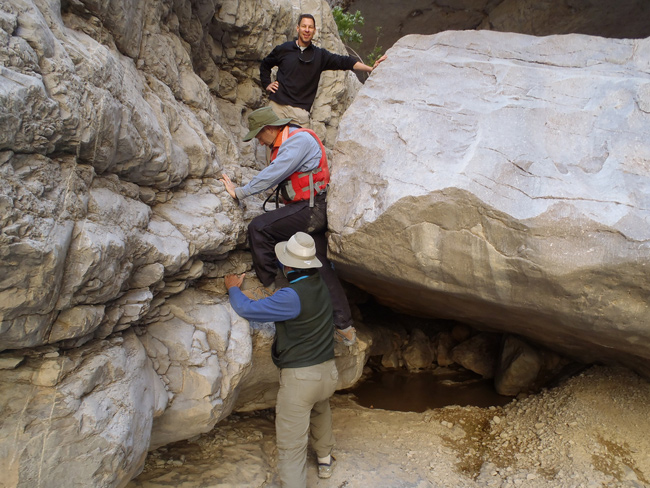
Go on one of the most adventurous
Slickrock Expeditions of ’08 by joining this
week-long exploration of Big Bend National Park and the Rio Grande. We’ll spend
the first half of the trip “base camping” at the park’s Cottonwood Campground
and taking day hikes from there (including hikes to the Devil’s Den, the Mule
Ears, Santa Elena Canyon, and the Chisos Mountains), and we’ll spend the second
half of the trip canoeing through the park’s stunning “stone box” river canyon,
Boquillas, and camping on the riverbank at night. In addition to the camping,
we’ll spend a night mid-week in the Stone Cottages of Chisos Lodge, in the
Chisos Mountains, and the last night at the historic and elegant cowboy hotel,
The Gage, in Marathon. Trip cost includes all camping and canoeing equipment,
all food when camping, hiking, canoeing, local transportation and shuttling,
park entrance fees, and the nights at Chisos Lodge and at the Gage. Trip starts
and ends in Midland, TX.
Cost: $1475 (deposit: $700.) Group Size: 12.
Dates: Nov. 2-9.
I wish we could
have had just one more night around the cookstove, just one more
bend in the river. The Rio Grande was everything you said it would
be and more. |
|
![]() |
| | What
We Do | Where We Go | About The Guide | | Theme Expeditions | Custom-tailored Expeditions | What Others Say | | HOME | |